Dhurandhar Re-Release Changes Censorship List: Every Cut, Mute & Difference
The Uncut / original version is gone. The SAFE version is here. This is not just a minor tweak. Dhurandhar re-release changes contains full blown strategic overhaul designed to keep the money flowing while dodging a legal bullet.
We have the exclusive details on the Dhurandhar re-release changes censorship list that the producers do not want you to analyze too closely
Quick View Of The Changes Made:
| Type Of Change | Scene | Original Version (Dec 5) | Re-Release (Jan 1) | Reasons |
|---|---|---|---|---|
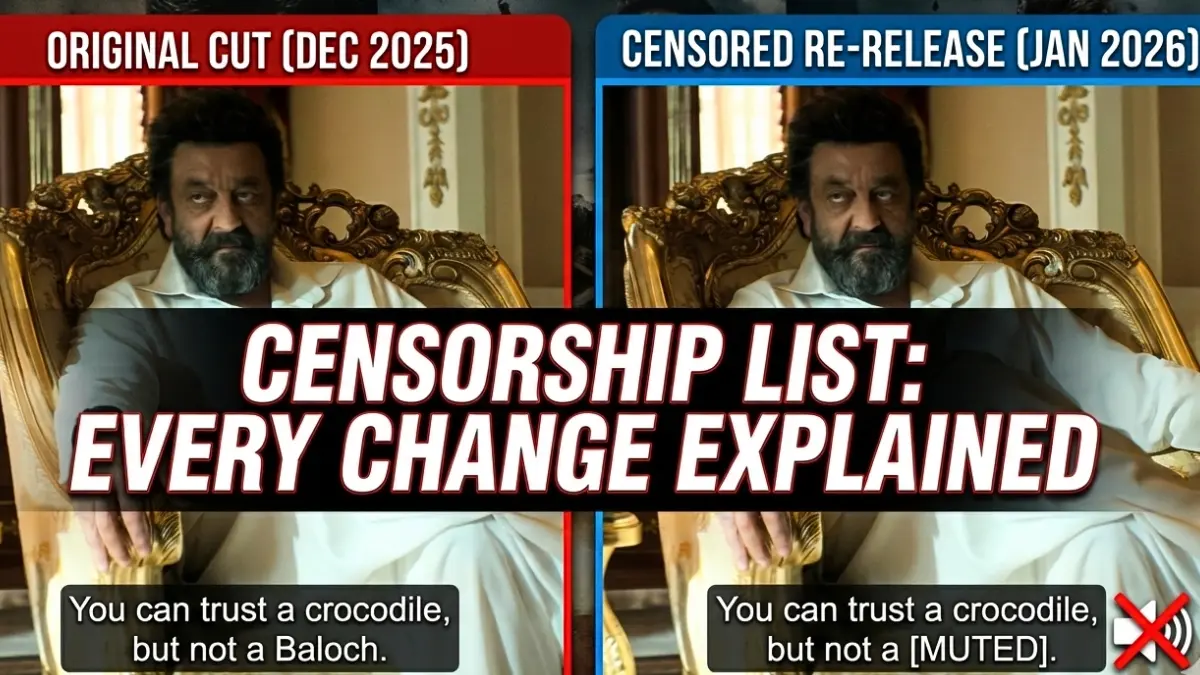
| Audio | Sanjay Dutt Dialogue | “Trust a crocodile, not a Baloch.” | “Trust a crocodile, not a […silence].” | Objections from Baloch community. |
| Audio | Intelligence Refs | Full references | Muted in specific lines | Avoided offense to agencies. |
| Audio | Profanity | Cuss word | Muted | CBFC ‘A’ rating compliance. |
| Visual | Opening Disclaimer | Static text | Hindi Voiceover added | Duration extended for audio. |
| Visual | Violence (Start) | Graphic head smash | Deleted/Replaced | CBFC gore reduction. |
| Visual | Violence (2nd Half) | Graphic torture | Reduced/Trimmed | General toning down. |
| Visual | Substance Use | Smoking/drugs | Static Warnings added | Mandatory compliance. |
| Visual | Minister Name | Government Minister | Name suitably changed | Avoided political resemblance. |
| Visual | End Credits | Standard | Extended + music/footage | Creative addition. |
| Subtitle | South Markets | No subtitles | Hardcoded English | Fixed Chennai/Bengaluru complaints. |
Dhurandhar Re-Release Changes Analyzed: Silence, Plastic Bags, and Voiceovers
Let us get straight to the forensic evidence. The changes made to Dhurandhar are surgical, but if you know where to look, they are glaring.
The most obvious alteration is the Silence. In the bad old days of the Censor Board, you would hear a loud, screeching BEEP when a character cursed. That was annoying, but honest.
This new method is far more Subtle. They have simply deleted the dialogue audio.
Dialogue Removed: The Baloch Line
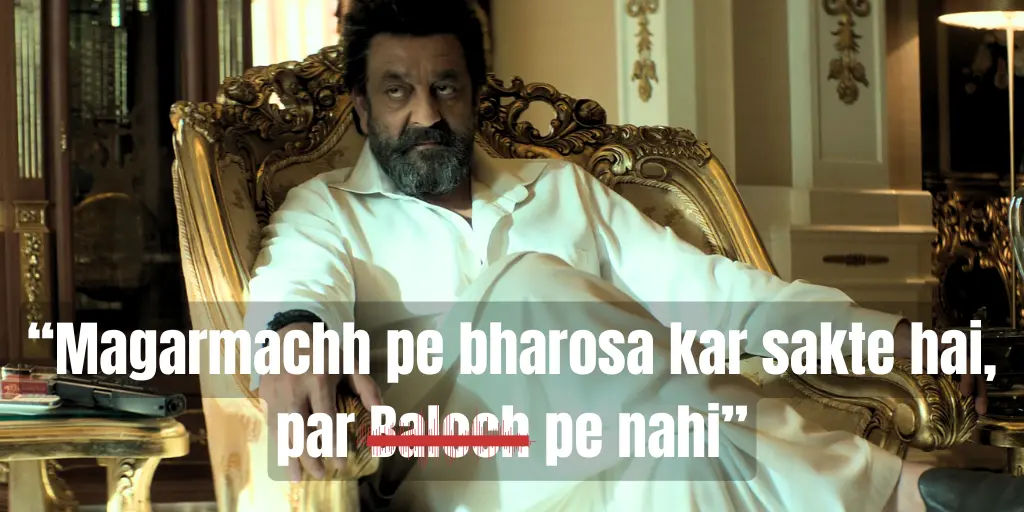
The controversy centers on Sanjay Dutt’s character, SP Chaudhary Aslam. In the original December 5 release, his gravelly voice delivered a line that shook the halls:
“Magarmachh pe bharosa kar sakte hai, par Baloch pe nahi“
Meaning: “You can trust a crocodile, but not a Baloch”
This line is now history. In the revised cut, the Sanjay Dutt crocodile dialogue muted technique is applied with jarring precision. The word “Baloch” has been removed completely. There is no dubbing. There is no replacement
word like “Dushman” (Enemy) or “Gaddar” (Traitor). Dutt says, “You can trust a crocodile, but not a…” followed by a dead drop in the audio. I
n a high-fidelity Dolby Atmos mix, this creates a vacuum. It is an air gap that sucks the energy right out of the scene. You see his lips move. You see the intensity in his eyes. You hear nothing. It breaks the immersion instantly.
The Intelligence Scrub
The censorship did not stop at ethnic identity. The word Intelligence found itself on the chopping block. Our sources confirm that references to “Intelligence” in specific scenes criticizing agency failures or corruption were muted.
The producers likely feared offending real-world agencies like the IB or RAW. Whenever the script got too close to institutional defamation, the audio simply cuts out.
Name Change
The censors also demanded a covert identity swap. A key supporting character portraying a Government Minister had their name suitably changed in this revised cut.
Insiders suggest the original name bore too strong a resemblance to a living politician, forcing the makers to redub the name to avoid a defamation lawsuit
Reduced Violence: The Plastic Bag and Boiling Scenes
The Dhurandhar uncut vs cut difference is most visible in the violence. Aditya Dhar directed an ‘A’ rated film, and he meant it.
The original cut featured a visceral, stomach churning sequence where a character is suffocated and their head is smashed using a plastic bag. It was gritty. It was uncomfortable. It was also toned.
The revised cut replaces this footage with alternate angles or trims the moment of impact to make it less grotesque. Similarly, a scene implying a character is boiled alive has been significantly trimmed.
The screams remain, but the visual confirmation of the torture is reduced. The gore factor has been dialed down from an 11 to a manageable 8.
The Disclaimer Expansion
Here is a detail only the highly observant would notice. The opening credits are longer. Why? The Central Board of Film Certification (CBFC) mandated the addition of a Hindi voiceover to the standard disclaimer text.
Previously, it was just static text on the screen. Now, you have to sit through a voice reading the legal text aloud. This forced the editor to extend the duration of the black screen before the first scene.
The Subtitle Patch
Finally, a fix for the fans in the South. During the initial release, viewers in Chennai and Bengaluru complained that the Hindi dialogue was hard to follow without subtitles.
The Jan 1 prints came with hardcoded English subtitles for these specific territories. It was a quality of life update with the censorship patch.
Did The Changes Hurt Box Office?
Did the censorship hurt the film? Absolutely not. In fact, the controversy acted like gasoline on a fire. Dhurandhar did not just survive the scandal. It thrived on it.
The film has registered the Dhurandhar 100 crore week 4 record, a milestone that defies all conventional box office logic.
The Numbers Do Not Lie. Let us look at the scoreboard. In its fourth week, Dhurandhar collected a staggering ₹106.5 Crore Net in India. Read that again.
Most hit films struggle to earn ₹10 crore in their fourth week. Dhurandhar earned ten times that amount.
To put this dominance in perspective, let us compare it to the previous titans of Bollywood:
- Dhurandhar (Week 4): ₹106.5 Cr
- Pushpa 2 (Hindi): ₹69.65 Cr
- Jawan: ₹34.53 Cr
- Animal: ₹8.93 Cr
Dhurandhar earned more in its fourth week than Jawan, Pathaan, and Animal earned in their fourth weeks combined. It is the first Hindi film in history to cross the century mark in Week 4.
The film maintained double digit collections (₹10 Cr+) for 28 consecutive days. That is four straight weeks of blockbuster business. The Uncut buzz drove people to theaters in December.
The censored news drove them back in January to see what changed.
Global Domination and the Gulf Loss
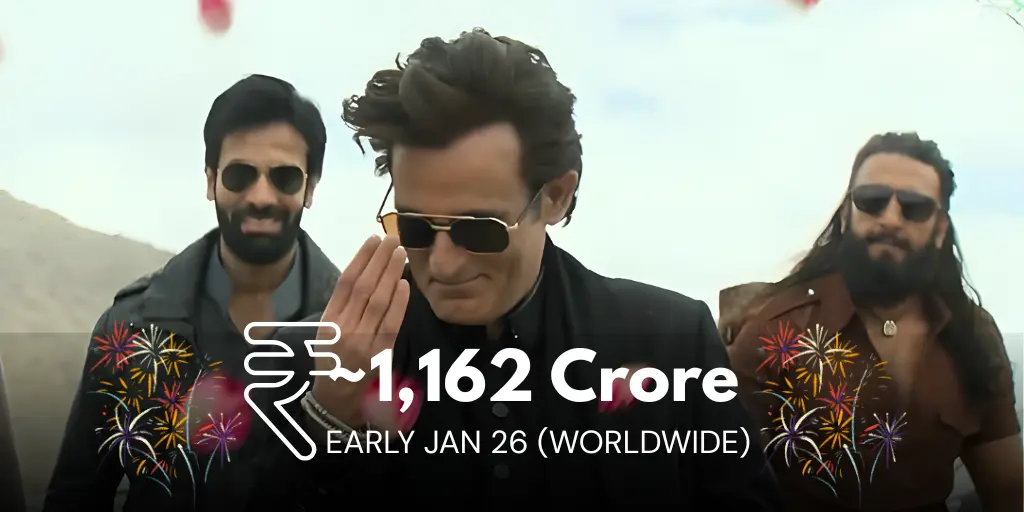
The worldwide gross now stands at a colossal ₹1,162 Crore. This number is even more impressive when you consider the Gulf Handicap.
The film was banned in all GCC countries (UAE, Saudi Arabia, Qatar, etc.) due to its geopolitical narrative. Trade analysts estimate this ban cost the producers approximately $10 Million (₹83 crores).
If the Gulf market had opened, Dhurandhar would currently be sitting at ₹1,250 Crore, challenging KGF 2 and RRR. However, North America stepped up to fill the void.
The film has crossed $17.5 Million in the USA/Canada market, beating Pathaan to become the third-highest-grossing Indian film in the region.
Common people did not care about the controversy. They just wanted to see Akshay Khanna’s performance.
FIND OUT: Dhurandhar Real vs. Reel: The Truth About Mohit Sharma, Rehman Dakait’s Matricide & The Real Spies
How They Got Away With The Rule 31 Legal Loophole
You might be wondering how they changed a movie that was already in theaters for four weeks. Did they have to recertify it? Did they have to face the Examining Committee again? No. They used a Cheat Code called Rule 31.
What is Rule 31?
n simple terms, Rule 31 of the Cinematograph (Certification) Rules is a provision that allows producers to make voluntary alterations to a film that already has a valid Censor Certificate.
The rule states that as long as the changes do not alter the larger meaning of the film, subject matter, or category (like moving from ‘A’ to ‘UA’) of the film, they can be approved rapidly without a full re-examination.
It is meant for minor tweaks. The producers of Dhurandhar used it to surgically remove the controversial bits to save their theatrical run.
The Voluntary Lie
This is where the story gets spicy. The official line from the Ministry of Information and Broadcasting (I&B) and the CBFC is that these cuts were voluntary.
They claim the makers proposed the changes on their own accord. That may be the case
However, the trade whispers tell a completely different story. Theater owners received urgent emails on December 31. These emails did not say, The director had a creative change of heart.
They explicitly stated that the Digital Cinema Packages (DCPs) were being recalled as per directives received from the Ministry of Information and Broadcasting.
This is the Voluntary Compliance Paradox. The government sends a suggestion. The filmmakers voluntarily agree to it to avoid a ban or a lawsuit. Everyone saves face.
The government denies censorship. The filmmakers deny buckling under pressure. But the email trail tells that this was a directive disguised as a choice.
Why The Re-Release? The Junagadh Petition
Why did this happen in Week 4? The pressure came from Junagadh, Gujarat. The Makrani Baloch community filed a petition in the Gujarat High Court.
They argued that the “Crocodile” dialogue constituted collective defamation and hate speech. They claimed it branded their entire community as untrustworthy animals.
Justice Aniruddha P. Mayee refused to grant an immediate stay on the film. He observed that the line reflected the opinion of a fictional character and was set in Pakistan, not India. But the legal pressure was mounting.
Community leaders threatened Gandhian style protests at cinemas in Gujarat.
The producers calculated the risk. Losing the Gujarat market was expensive. Losing the entire theatrical run due to a potential escalation was catastrophic. They chose the mute button.
FACTS EXPLAINED: Is Jaskirat Singh Rangi Real? Dhurandhar Part 2 Story Predictions & The Uri Connection
Fan Reaction To The Changes & Sequel Hype
Fans feel the silence ruins the flow of Sanjay Dutt’s performance. They call it “jarring” and “immersion-breaking.” One user noted, “It feels like the audio driver crashed for a second.”
But for the general Mass audience? It does not matter. The story holds up. The action is relentless. The edits are minor enough that the casual viewer barely notices them amidst the explosions.
The narrative integrity remains intact. The Anti-Pakistan realism tone that drove the initial wave of success is still there, just slightly polished around the edges.
Despite the audio cuts, the technical aspects of the film continue to be praised by the audience. Grammy Award
winner Ricky Kej took to social media to praise the film’s score and technical brilliance, proving that the artistic merit of the film transcends the political noise.
The best news for fans is that this train has no brakes. The end credits confirm that Dhurandhar 2 Revenge is locked and loaded. The release date is set for March 19, 2026.
Explained: Dhurandhar Part 2 Akshaye Khanna Flashback Cameo: Ghost Theory vs. Reality
Final Thoughts
In my openion The January 1 re release was a masterclass in crisis management. The producers muted a word, saved their Gujarat screens, avoided a legal stay, and used the noise to power their way to a historic ₹100 Crore fourth week.
If you managed to see the uncut version in December, consider yourself lucky. You hold a memory of a version that no longer legally exists. For everyone else, the SAFE version is playing in a theater near you,
and it is still breaking records. The January re-release worked. The crocodile survived. The box office survived. Only the silence speaks the truth.
Let me know Your Thoughts On These Changes In Comments Below!
Dhurandhar