
Dhurandhar Ending Explained: The Jaskirat Twist, Timeline Plot Holes, and What the Post Credit Really Means
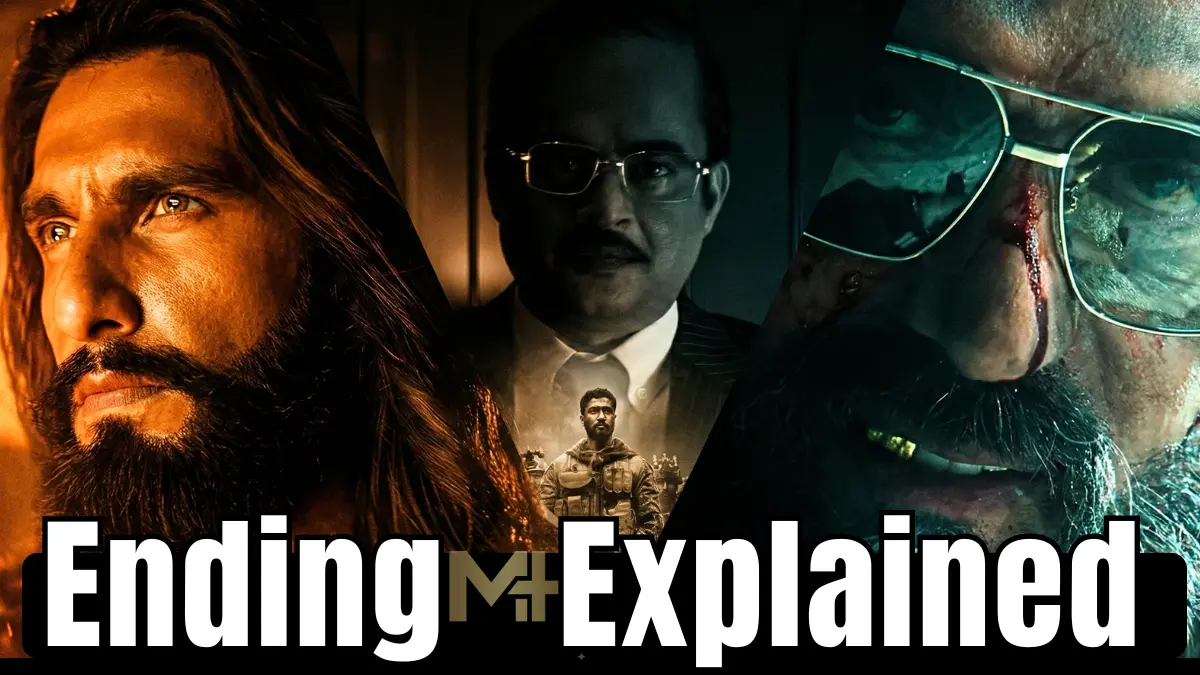
The ending reveals an identity twist. It shows us a hallucination that uncovers the mental stress. It also sets up a sequel that is coming out in March. But this big ending also creates problems.
Fans are arguing online about the timeline and the age of the main character. I checked every scene closely. I read the fan theories. Here is the definitive Dhurandhar ending explained.
Warning: Spoilers!
Who Is Hamza Ali Mazari?

The main reveal twist happens at the climax. For the whole movie, we watch Ranveer Singh play as Hamza Ali Mazari, a rough man.
He fights his way into the gangs of Lyari in Pakistan. We think he is a soldier, a trained intelligence officer, a spy using a fake name. That assumption is not the whole truth.
In that flashback of 2002. We see Ajay Sanyal (Chief of the Intelligence Bureau) walk into a prison. He is not looking for a soldier.
He is looking for a criminal. He meets a young man on death row, Jaskirat Singh Rangi. This twist changes the whole film and explains some of the scenes. Jaskirat is not a normal spy or a trained officer. He is a convict.
Sanyal gives him a choice. He can die here, or he can go to Pakistan and live for his country. Jaskirat chooses the mission. This explains why Hamza is so brutal. He kills rival gangsters without blinking.
He lies to everyone. His ruthlessness does not come from training; it’s a desperate survival instinct of a man with no other option but death.
Jaskirat Singh Rangi Uri Connection
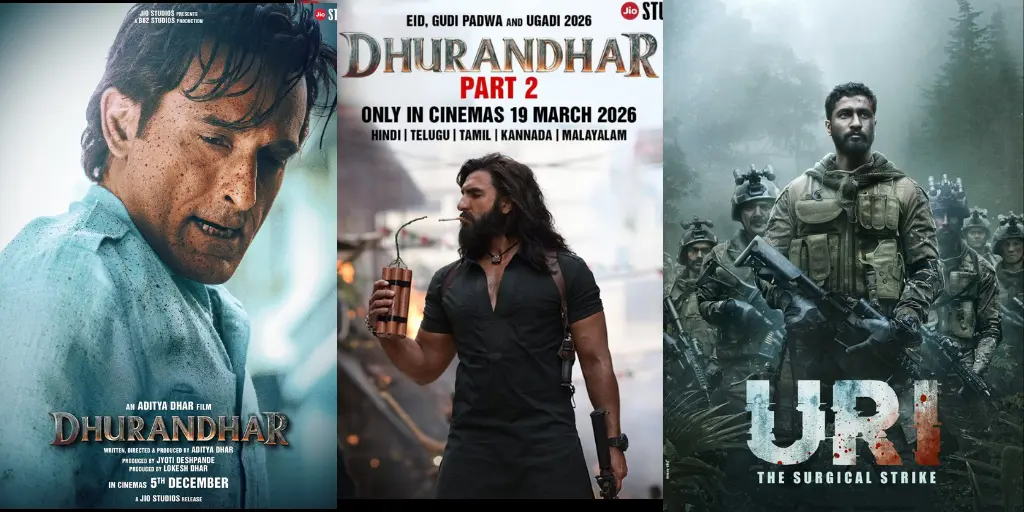
Jaskit Singh Rangi, is not just a made up charecter name for this movie, It already been mentioned in Aditya Dhar’s Previous movie, Uri: The Surgical Strike. In Uri, Flight Lieutenant Seerat Kaur (played by Kirti Kulhari) says a specific line about her late husband.
“Husband the. Captain Jaskirat Singh Rangi. Naushera sector ke ambush mein shaheed hue the.”
This connects the 2 movies; Uri: The Surgical Strike might be an indirect sequel. If Aditya Dhar is going for a Spy Cinematic universe.
The Jaskirat in Dhurandhar is the same man mentioned in Uri. But he is a death-row inmate recruited as a spy. In Uri, he is remembered as a Captain who died in an ambush.
Dhurandhar And Uri: The Timeline Paradox
So the debate is, are they actually the same person? Most likely, yes. But the scenario doesn’t match. It is likely due to a cover-up. No government could claim they sent spies, so the captain rank could just be a cover-up or after his successful mission in Pakistan,
he comes back and gains the captain rank and dies in an actual ambush. Either way It adds a tragic layer to the character. He fights for a country that cannot even acknowledge his true existence until he is dead.
Et Tu Brutus Betrayal
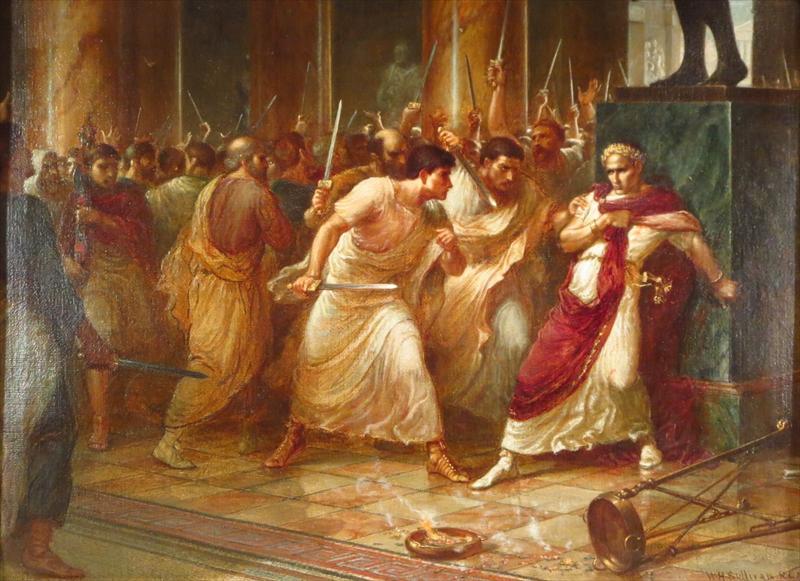
The final part of the film, titled “Et Tu Brutus”, is a popular phrase and originated from the play Julius Caesar by Shakespeare. It means “You Too Brutus”.
It screams that the betrayal is coming. Hamza tries not just to blend in; he spends the entire movie becoming the right-hand man of Rehman Dakait (Akshaye Khanna). Rehman respects him as his most trusted man.
Hamza wepanized this love and planned a calculated betrayal. I broke down the mechanics of the betrayal.
Hamza learned that Rehman is paranoid, but he trusts him implicitly. Hamza manipulates the timing of a weapons delivery to happen on the same date as a water pipeline inauguration day.
He exploits Rehman’s distraction at his wedding and fixes the date of the ambush. Hamaza manipulate Rahaman’s brother to send him away to take the weapons delivery.
Hamza planned the ambush with the officer SP Chaudhary Aslam (Sanjay Dutt) and Rehman’s rival politician Jameel Jamali (Rakesh Bedi).
But the most chilling part is what happens at the hospital. Hamza brings the mortally wounded Rehman to the ER. He acts to fool the everyoone, he screams. He thrashes. He cries. He begs the doctors to save him.
He stages this public performance of devastation to maintain his cover.
If he looked guilty, they would suspect him, and he is on a long-term deep cover mission. By appearing as the one who also fell into the trap with Rehman and tried everything to save Rehman, he inherits the loyalty of Rehman’s gang. The grief was a strategic tool, weaponised to ensure succession.
The film also adds a layer of psychological exhaustion. Upon returning home to his wife, Yalina, Hamza collapses and begs for food in a state of hysterical breakdown.
This private grief contrasts sharply with the public performance. It suggests that while the betrayal was calculated, the emotional toll was genuine. He killed a man who trusted him.
Hamza’s Hallucination Explained
At the hospital, After Rehmans death, when adrenaline fades, we get the scene of Hamza’s psychological state. Hamza walks down a hospital corridor.
He sees Rehman Dakait sitting on a stretcher. Rehman is soaked in bloodand smoking a cigarette. He stares right at Hamza with an intense gaze.
This hallucination is the manifestation of Hamza’s psyche. He killed the man who truly trusted him. The “Et Tu Brutus” title pays off here.
Brutus killed Caesar for the good of Rome, but he was haunted by it. Hamza killed Rehman for the good of India, but the ghost of his victim remains. It signifies that Hamza has crossed a line. He is no longer just a soldier; he is a betrayer in his mind.
During the discussion on this topic, one Reddit user said, “The scene where Hamza sees Rehman sitting on the hospital stretcher, it gave me chills. It reminded of ‘Hamlet’ and how Hamlet used to be haunted upon seeing his father’s ghost.”
People are praising Akshay Khanna’s performance as Rehman Dakait. This scene gives Aditya Dhar a chance to show him again in part 2, not as alive, but as a ghost in Hamza’s mind.
find more: Dhurandhar Part 2 Akshaye Khanna Flashback Cameo: Ghost Theory vs. Reality
Dhurandhar Plot Holes
While the emotional beats land, the logic has some serious cracks. My research for this Dhurandhar ending explained article uncovered significant timeline issues that are impossible to ignore.
The Age Gap
The flashback establishes that Jaskirat was recruited in 2002. He is described as a “20-year-old boy” or a young convict at this time. Ranveer Singh is 40. The film tries to hide this with lighting and makeup, but it is distracting.
It stretches credibility to see a 40-year-old man playing a 20-year-old convict. It pulls you out of the experience. The dissonance between the actor’s physical maturity and the character’s supposed youth in 2002 is a major point of contention.
The Double Agent Debate
A small group of the audience theorises that Hamza might be a double agent or at least morally compromised. This theory comes from his deep integration into the enemy’s world.
Hamza’s ruthlessness in honey trapping Yalina (an innocent woman) and his participation in the gang’s violence blur the line between cover and reality.
Some claimed that he enjoyed the power too much, citing his rise to become the King of Lyari. But the invisible Ink scene and his breakdown before Yalina suggest his loyalty to India remains intact.
His actions are framed as the terrible necessity of his mission. The film explicitly shows him mourning the 26/11 attacks, reinforcing his motivation.
He is not a traitor to India, but psychologically exhausted.
Dhurandhar Post Credit and Part 2 Sequel Setup
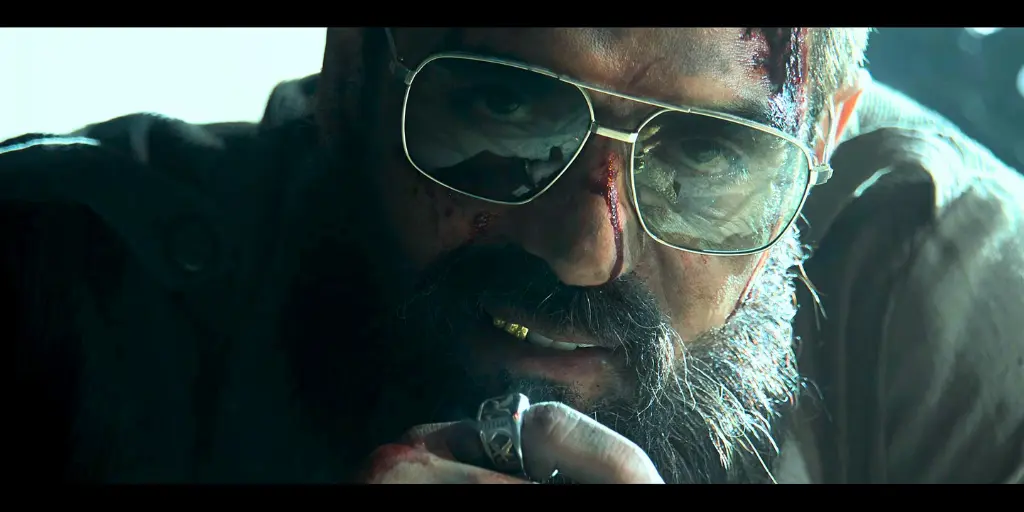
The post-credits scene is not just a teaser; it’s a mission statement. I analysed the Invisible Ink sequence to understand where the Part 2 story is going.
Hamza wakes up in the dead of night. He retrieves a secret diary handed to him by his handler, Mohammed Aalam. The pages appear blank. He applies a liquid chemical to the paper. Text appears.
The first name is revealed to be Rehman Dakait. Hamza strikes a line through it. This symbolises that he completed Phase 1 of his mission successfully. Then he turns the page, and a new list of targets appears. The name at the top is Major Iqbal.
This confirms the plot of Dhurandhar 2. The sequel will move from the gang wars of Lyari to the state-sponsored terror apparatus of the ISI. We also get a visual confirmation of the antagonist. Major Iqbal is played by Arjun Rampal.
The post-credits montage includes brief flashes of a combat sequence between Ranveer Singh and Arjun Rampal.
I verified the release details through multiple sources. Dhurandhar 2 is going to release on March 19, 2026. It is positioned as a revenge saga. Hamza is done infiltrating. Now, he is hunting.
Real-World Inspirations
You cannot discuss this ending without looking at the real history the film was inspired by. The film is deeply rooted in the real-world geopolitics of the Indian subcontinent.
The character of Rehman Dakait is based on the real-life gangster Sardar Abdul Rehman Baloch. He was a central figure in the Lyari gang wars and was killed in a police encounter led by Chaudhary Aslam.
The film fictionalises his death by involving an Indian spy in the plot, but the core events mirror reality.
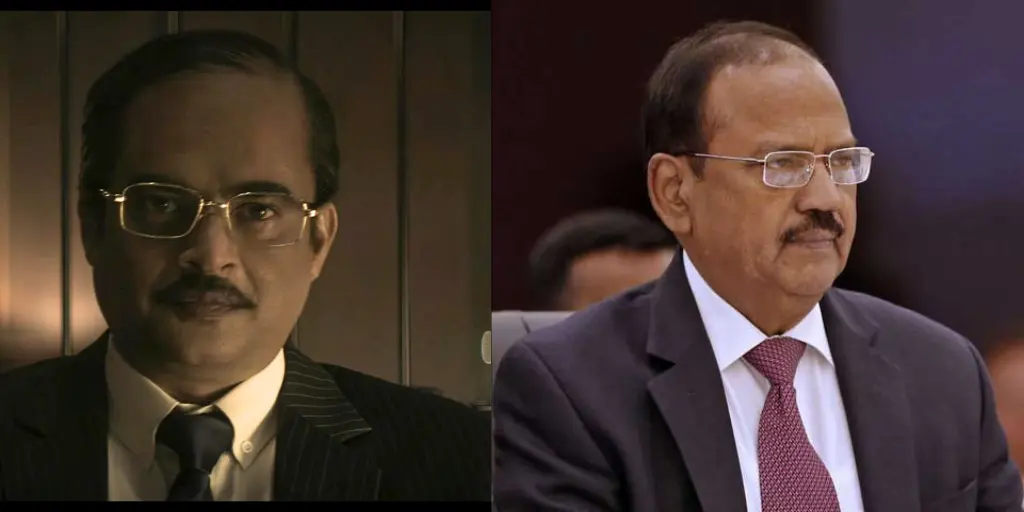
Then there is Ajay Sanyal. R. Madhavan plays him with a quiet, terrifying intensity. He is widely interpreted as a cinematic proxy for Ajit Doval, India’s National Security Advisor. Sanyal’s lines about “offensive defence” and the “New India” doctrine mirror Doval’s public strategic philosophy.
The film concludes with a dialogue that has become a lightning rod for debate:
“Yeh naya Hindustan hai, ye ghar mein ghusega bhi aur marega bhi.”
This line is a direct callback to Uri. It cements the film’s political stance. It argues that the only way to stop terror is to cross borders and kill the architects in their homes. While some critics label this as propaganda, fans view it as a moment of cleansing.
Explained: Dhurandhar Real vs. Reel: The Truth About Mohit Sharma, Rehman Dakait’s Matricide & The Real Spies
Final Thoughts
Dhurandhar was a beast. The ending lands a massive punch. It transforms a standard action movie into a tragedy about a man who loses his identity to save his country. The Jaskirat reveal works because it hurts.
The movie has polarised audiences. Some see it as a revenge fantasy. But others see it as a masterclass in spy fiction that acknowledges the reality of terror. But everyone agrees on one thing:
the sequel setup is undeniable. When Hamza crosses that name off his list, you know the next chapter will be a bloodbath. March 2026 cannot come soon enough.
MORE ON DHURANDHAR:
Is Jaskirat Singh Rangi Real? Dhurandhar Part 2 Story Predictions & The Uri Connection
Dhurandhar Re-Release Changes Censorship List: Every Cut, Mute & Difference
Dhurandhar










you got a very fantastic website, Gladiola I found it through yahoo.
Thank You For Visiting Our Site! Hope You Like Our Content